The most common link building mistake isn’t bad links. It’s good links pointed at the wrong pages. Budget spent on a page that can’t convert, or one that’s nowhere near ranking, does little for your business.
Here’s the simple framework we use to decide where links go first.
Step 1: List pages that make you money
Start with the pages that turn visitors into customers: service pages, product or category pages, and pricing pages. These are your “money pages”. A ranking gain here shows up in revenue, not just traffic charts.
Step 2: Find your striking-distance pages
Open Google Search Console and filter for queries where your money pages rank roughly between positions 5 and 20. These pages are close. Search engines already see them as relevant, and a few strong links can push them onto page one, where most clicks happen.
Step 3: Check the page is ready to rank
Links amplify what’s already there. Before you build any, make sure the page:
- Answers the search intent better than the pages above it.
- Has a clear title, headings and helpful content.
- Loads fast and works well on mobile.
- Is linked from other relevant pages on your own site.
If it falls short, fix the page first. Links pointed at a weak page are links half wasted.
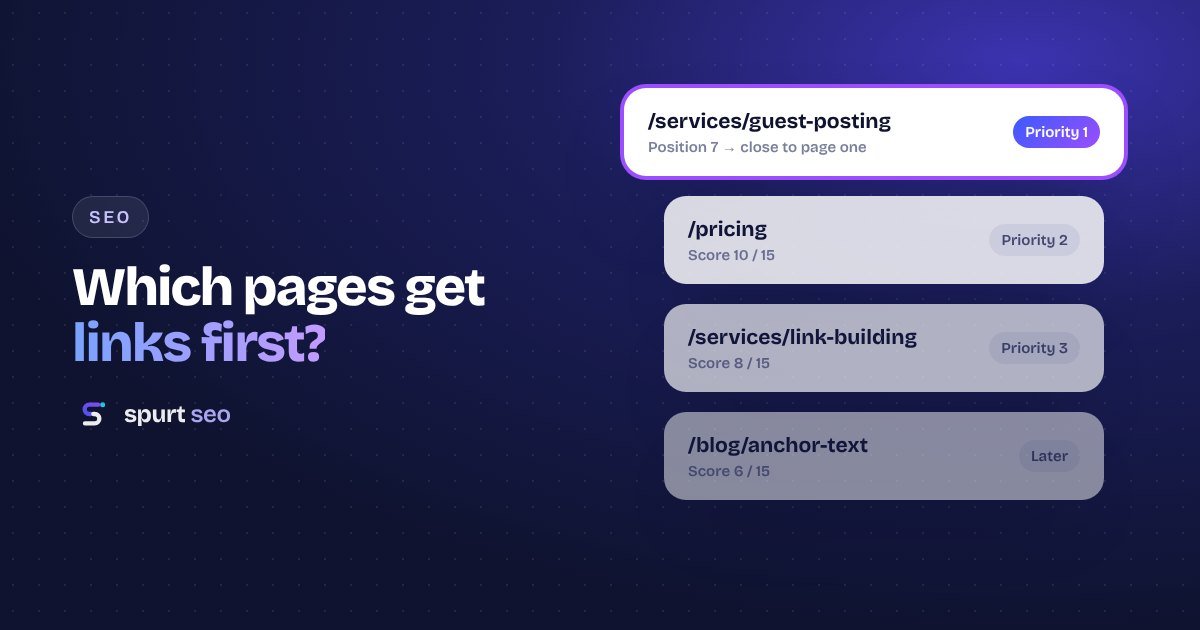
Step 4: Score and rank your shortlist
Give each candidate page a quick score from 1 to 5 on three questions, then add them up:
| Question | What a 5 looks like |
|---|---|
| Business value | Directly drives leads or sales |
| Ranking distance | Already in positions 5–10 |
| Page readiness | Strong content, fast, well linked internally |
The highest scores get links first. Everything else waits for the next round.
How many links does a page need?
There’s no fixed number. The useful question is: how many quality, relevant links do the pages above you have? Compare your page with the top results for its main keyword. If they each have links from a dozen relevant sites and you have two, you know the size of the gap. If they have fewer than you, the problem is probably the page itself, not links.
Plan links in small batches, review the results, then decide on the next batch. That’s far safer and cheaper than buying a large package for one page in one go.
Step 5: Support with content and internal links
Guest posts and link insertions bring authority into your site. Internal links decide where that authority goes. Link from your strongest pages and helpful blog posts to the money page you’re pushing, using descriptive anchors.
This is where content strategy and link building meet. A cluster of helpful articles around a topic gives you natural places to link from, and more reasons for other sites to link to you.
A quick example
Imagine an online store with three candidate pages:
- Running shoes category: drives most sales, ranks around position 8. Business value 5, distance 5, readiness 4. Score: 14.
- Brand story page: rarely converts, already ranks for the brand name. Score: 6.
- Trail shoes guide: helpful content, ranks around position 18, links to the category. Score: 10.
The category page gets links first. The guide comes next, because it ranks and feeds authority to the category through internal links. The brand page can wait.
Pages that usually aren’t worth links yet
- Pages with thin or outdated content that need a rewrite first.
- Pages targeting keywords nobody searches for.
- Pages competing with each other for the same keyword. Merge or clarify them first.
- Pages that are blocked from indexing or slow to load.
Step 6: Measure, then move on
Track rankings and clicks for each page you build links to. Once a page reaches the top three for its main keyword, shift budget to the next page on your list. Link building works best as a rolling plan, not a one-off purchase.
Need help choosing? Our free audit includes a shortlist of the pages where links will do the most for you. And once you know your targets, plan a safe anchor text mix for each one.
Key takeaways
- Prioritise pages that drive revenue.
- Start with pages already ranking in positions 5–20.
- Fix the page before you build links to it.
- Use internal links to send authority where it’s needed.
Frequently asked questions
Should I build links to my homepage?
Your homepage usually earns branded links naturally. Most campaigns get better results by sending links to service, product or category pages that target commercial keywords.
What are striking-distance keywords?
Keywords where your page already ranks around positions 5 to 20. These pages are close to page one, so a few quality links often make a visible difference.
Can I build links to blog posts?
Yes. Links to helpful blog posts can earn rankings on their own and pass authority to your money pages through internal links.

Connect on LinkedIn →
Want links like these working for you?
Guest posting packages from $100 for 5 posts. Every site approved by you.