Buying a guest post is easy. Buying one that actually helps your rankings is not. Plenty of sites look strong on paper, with high DA or DR, yet have no real readers and sell links to anyone who pays. A link from a site like that rarely moves anything.
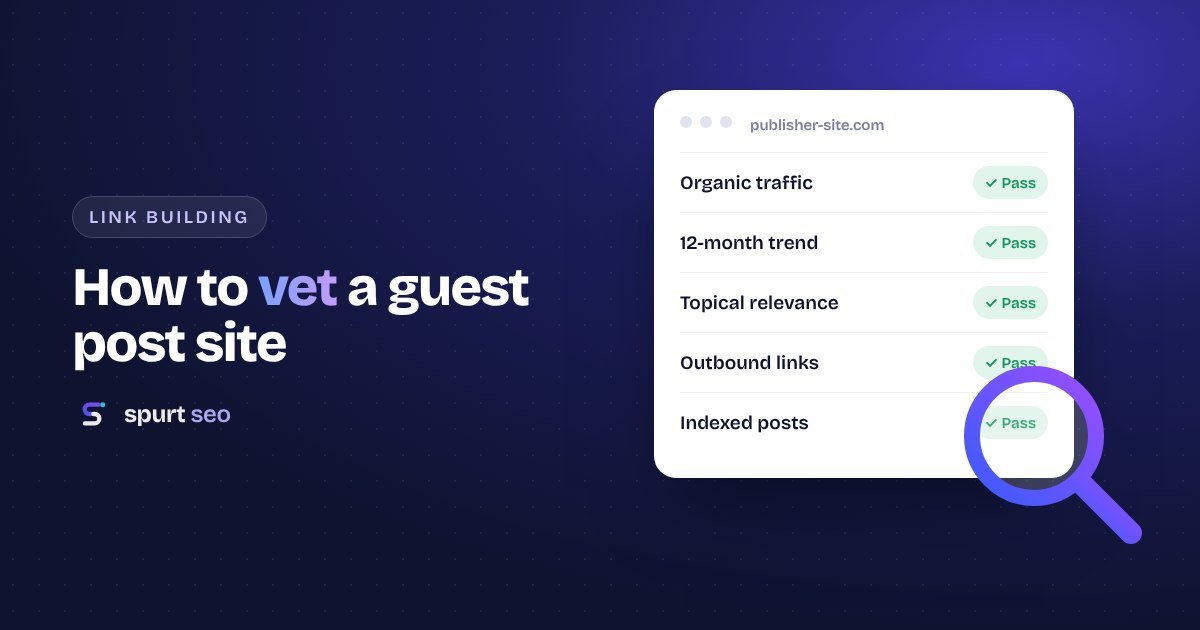
Here are the nine checks we run on every site before it reaches a client’s shortlist.
1. Check real organic traffic, not just authority
Domain Authority (DA) and Domain Rating (DR) estimate link strength, but they can be inflated. Organic traffic is much harder to fake. Look for a site that gets real visits from search, ideally in the countries your customers are in.
2. Look at the 12-month traffic trend
A single traffic number hides the story. Open the trend graph. A steady or rising line is a good sign. A sharp drop often points to a penalty or a core update hit, and links from that site may carry less weight than its metrics suggest.
3. Confirm topical relevance
A link from a site in your niche is worth far more than one from a general site that writes about everything. Ask: would my customers actually read this site? If the answer is no, keep looking.
4. Count outbound links per post
Open a few recent articles and count the external links. If most posts carry several dofollow links to unrelated businesses, the site is selling links at scale. Your link becomes one of many, and search engines notice the pattern.
5. Scan the “write for us” footprint
Many sites advertise guest posting openly, which isn’t a problem on its own. Be careful when the site’s main purpose seems to be selling posts, with price lists, “sponsored post” tags on everything and little original content of its own.
6. Check that posts get indexed
Search Google for a few recent guest articles on the site. If they don’t show up in the index weeks after publishing, your link may never be seen either. Every link we deliver is checked for indexing after it goes live.
7. Read the content quality
Read two or three articles properly. Are they useful, well written and edited? Or thin, spun and stuffed with keywords? Quality publications protect their reputation, and that protects the value of your link.
8. Look for spam signals
- Topics that jump from casinos to crypto to health in the same week.
- Pages full of ads with little real content.
- Sudden spikes in referring domains from low-quality sites.
- Author pages with no real people behind them.
9. Confirm the link terms in writing
Before you pay, agree on the basics: dofollow or not, permanent or time-limited, and where the link will sit in the article. In-content links inside relevant paragraphs are worth far more than links in author bios or footers.
What a good guest post site looks like
Put all the checks together and a strong publisher is easy to recognise. It has a clear topic and a real audience. Its traffic comes from search and has held steady for a year. Its articles are edited, useful and link out sparingly. And when you ask about link terms, the answers are clear and in writing.
Sites like that are harder to find and often cost a little more. They’re also the ones that actually move rankings, which makes them cheaper in the long run than a pile of links that do nothing.
Where to find this data
You don’t need a dozen tools to run these checks. Most of them take a few minutes each:
- Traffic and trend: any major SEO tool (such as Ahrefs, Semrush or Similarweb) shows estimated organic traffic and its history. Treat the numbers as estimates and focus on the direction of the line.
- Indexing: search Google for
site:plus the article URL, or the exact article title in quotes. - Outbound links: open the article, then use your browser’s “find” to count links, or a free link-checker extension.
- Relevance and quality: no tool replaces reading the site for five minutes like a real visitor would.
Questions to ask the publisher
A good publisher answers these clearly. If the answers are vague, take that as a signal.
- Will the link be dofollow and permanent?
- Will the post be marked as sponsored, and where?
- Can I review the article before it goes live?
- Where in the article will the link appear?
- Will the post be added to your category pages or internal links?
A quick checklist you can copy
| Check | Green flag | Red flag |
|---|---|---|
| Organic traffic | Real, steady, right countries | Near zero or collapsing |
| Relevance | Clear match with your niche | Writes about everything |
| Outbound links | Few, editorial | Many dofollow links per post |
| Indexing | Recent posts indexed | Guest posts missing from Google |
| Link terms | Dofollow, permanent, in-content | Vague or “no guarantees” |
Prefer to skip the homework? Every site in our guest posting packages has already passed these checks, and you approve each one before anything is published.
Key takeaways
- Traffic and its trend matter more than DA or DR alone.
- Relevance beats raw authority.
- Too many outbound links is the clearest sign of a link farm.
- Agree on dofollow, permanence and placement before you pay.
Frequently asked questions
Is DA or DR enough to judge a guest post site?
No. DA and DR estimate link strength, but they can be inflated. Always check real organic traffic, its trend over time, relevance and how many outbound links the site already sells.
How much traffic should a guest post site have?
There’s no single number. What matters is that the traffic is real, comes mostly from search in the countries you care about, and is stable or growing rather than collapsing.
What is a link farm?
A link farm is a site that exists mainly to sell links. Signs include posts on every topic, dozens of outbound links per article, little real traffic and pages written only to host links.

Connect on LinkedIn →
Want links like these working for you?
Guest posting packages from $100 for 5 posts. Every site approved by you.