Anchor text is the clickable text of a link. It tells search engines what the linked page is about, which is exactly why it’s easy to overdo. A backlink profile where every link says the same keyword doesn’t look like real people linking to you. It looks like someone bought links.
Here’s how to plan an anchor mix that helps rankings and still looks natural.
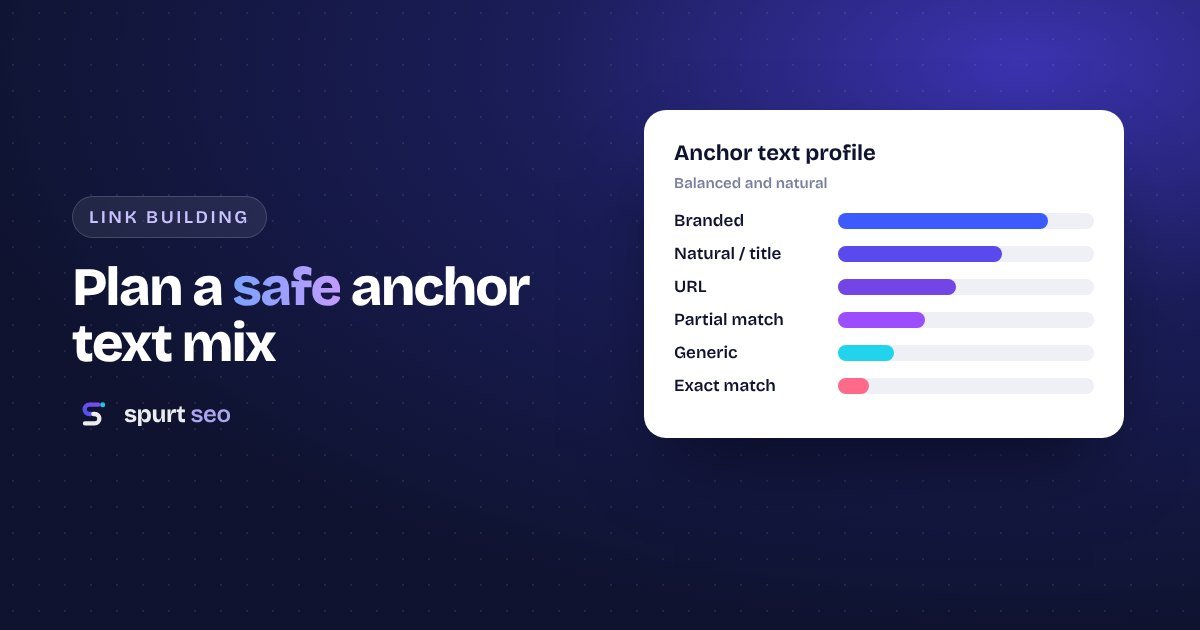
The main types of anchor text
| Type | Example (for a page about guest posting services) |
|---|---|
| Branded | Spurt SEO |
| Naked URL | spurtseo.com |
| Generic | read more, this guide |
| Partial match | guest posting packages for small brands |
| Exact match | guest posting services |
| Natural phrase / title | how Spurt SEO vets publishers |
Why a natural mix matters
When people link on their own, they use whatever words fit the sentence: your brand, your page title, a phrase from your article, or just “this post”. That variety is normal. A profile dominated by one commercial phrase is not, and search engines have been looking for that pattern for years.
Start with the pages that already rank
The most reliable guide is your competition. Look at the pages ranking in the top five for your target keyword and review their backlink anchors. You’ll usually see branded and natural anchors leading, with exact-match anchors as a small slice. That’s your benchmark, not a fixed ratio from a blog post.
A practical way to plan a campaign
- Audit what you have. Export your current anchors and group them by type.
- Set the direction. If you’re already heavy on exact match, the next links should be branded or natural.
- Assign anchors per placement. Plan the anchor for each guest post before it’s written, so the mix stays balanced across the whole campaign.
- Let the article decide the wording. The anchor should read naturally in its sentence. If it sounds forced, change it.
- Review every month. Track anchors as new links go live and adjust the next batch.
Choosing the right anchor for each type of page
Different pages call for different anchors. A rough guide:
- Homepage: mostly branded and naked URL anchors. That’s how people naturally link to a company.
- Service or product pages: a mix of partial match, natural phrases and branded anchors, with the occasional exact match.
- Blog posts and guides: the article title or a descriptive phrase, such as “this guide to anchor text”.
The surrounding sentence matters as much as the anchor itself. A branded anchor inside a paragraph about guest posting still tells search engines what the page is about.
A worked example
Say you’re building ten links to a page about guest posting services. A balanced plan might look like this:
| Links | Anchor type | Example |
|---|---|---|
| 3 | Branded | Spurt SEO, the Spurt SEO team |
| 2 | Natural phrase | how they vet every publisher |
| 2 | Partial match | affordable guest posting packages |
| 1 | Naked URL | spurtseo.com |
| 1 | Generic | this agency |
| 1 | Exact match | guest posting services |
This is an illustration, not a formula. Always adjust it to what you already have and what’s ranking in your niche.
Signs your anchors need rebalancing
- The same commercial keyword appears in most of your recent links.
- Rankings dropped after a burst of keyword-heavy links.
- Your brand name barely appears in your backlink profile.
How to fix an over-optimised profile
If your anchors already lean too heavily on one keyword, you don’t need to panic or delete links in a hurry. Rebalance gradually:
- Pause exact-match anchors for that page in your next campaigns.
- Build branded and natural links until the mix looks closer to the pages that rank.
- Ask publishers to adjust anchors on a few of the most aggressive recent links, where they’re willing to.
- Review spammy links you didn’t build. Most are simply ignored by search engines, but keep an eye on sudden spikes.
- Strengthen the page itself so it earns links naturally over time.
Anchor text and internal links
Internal links are the safer place to use descriptive, keyword-rich anchors, because you control your own site. Use them to point your strongest pages at the ones you want to rank, and keep external anchors more varied.
Anchor planning is part of every campaign we run. You’ll find it in our link building service, and it pairs well with choosing which pages to build links to first.
Key takeaways
- Branded and natural anchors should lead your profile.
- Use exact-match anchors sparingly and on purpose.
- Benchmark against pages that already rank, not a generic ratio.
- Plan anchors per placement and review them monthly.
Frequently asked questions
What is a good anchor text ratio?
There’s no universal ratio. A safe profile is led by branded and natural anchors, with exact-match anchors used sparingly. Compare your page with the pages already ranking for the same keyword.
Can exact-match anchor text get me penalized?
Overusing it can. A backlink profile where most anchors are the same money keyword looks manipulated, and search engines may discount those links or the page.
Should every guest post use a keyword anchor?
No. Many of the strongest links use your brand name, the page title or a natural phrase. Vary anchors across the campaign and choose what reads naturally in each article.

Connect on LinkedIn →
Want links like these working for you?
Guest posting packages from $100 for 5 posts. Every site approved by you.